
Find your stage
For an income-focused start, fill your plot, prioritize useful Money and Luck upgrades, and protect your best copies before selling. Then work toward a Rebirth, improve the units you keep and turn Tower rewards into your next upgrade. Pick the first row that describes your account.
| Your account now | Next milestone |
|---|---|
| New account or empty plot positions | 1. Fill your earning slots and collect cash |
| Your plot earns cash, but purchases feel random | 2. Choose an early upgrade or dice target |
| Your cash is approaching the Rebirth requirement | 3. Prepare your first reset |
| You have useful copies and resources to invest | 4. Build a team worth keeping |
| You need Gems, Trait Rerolls or potions | 5. Establish a useful Tower farm |
| You can repeat the loop and are chasing expensive tiers | 6. Plan the next large purchase |
Watch the next action for your stage
Use one of these starting points alongside the six-stage route. CHALLS shows the upgrade menu, inventory habit, a reset and the path to Towers.

Choose a time to load the player, then press Play. YouTube connects only when you load a video; playback may include ads. Video privacy.
CHALLS · Anime Dice Guide! (Best Dices, Upgrades, Tips & Tricks) ROBLOX
Watch this segment on YouTube ↗
This is a developed account. The reset segment uses a later $500M requirement; the first recorded reset is $50K. Follow the action, not the creator's balance. The cover is the creator's promotional artwork, not a stats reference.
Your noob-to-pro route
These are suggested spending milestones, not game unlock requirements or a fixed timetable. You can revisit an earlier step whenever a new roll, full backpack or changed shop price becomes your next bottleneck.
1. Turn your first rolls into income
Do this: finish the tutorial, roll characters and place earning copies in your available plot positions. Walk onto their cash pads to collect. Compare a new copy's displayed Income/s with the one it would replace; inspect Damage and Health separately if you want to keep a fighter.
Before claiming code rewards, pause Auto Roll and check Auto Sell. Resume when you are ready to use the spins with your intended boosts. Keep useful copies before selling duplicates.
Move on when: your available earning positions are occupied, collecting a pad increases your cash, and you know your team's current income. If you stall: check empty positions and uncollected pads first. For a full backpack, inspect keepers, sell unwanted copies and confirm rolling resumes.
Watch CHALLS at 1:17–1:32: equip before selling. His account is already developed; follow the inventory habit, not his cash balance.
2. Give your early cash one job
Do this: for cash growth, compare Money and Luck before Damage or Health. The recorded starting prices are Money I $250, Luck I $500 and Fire dice $2.5K for 5× displayed Luck. Those are individual reference prices, not a compulsory purchase order; use the nodes and dice currently available in your shop.
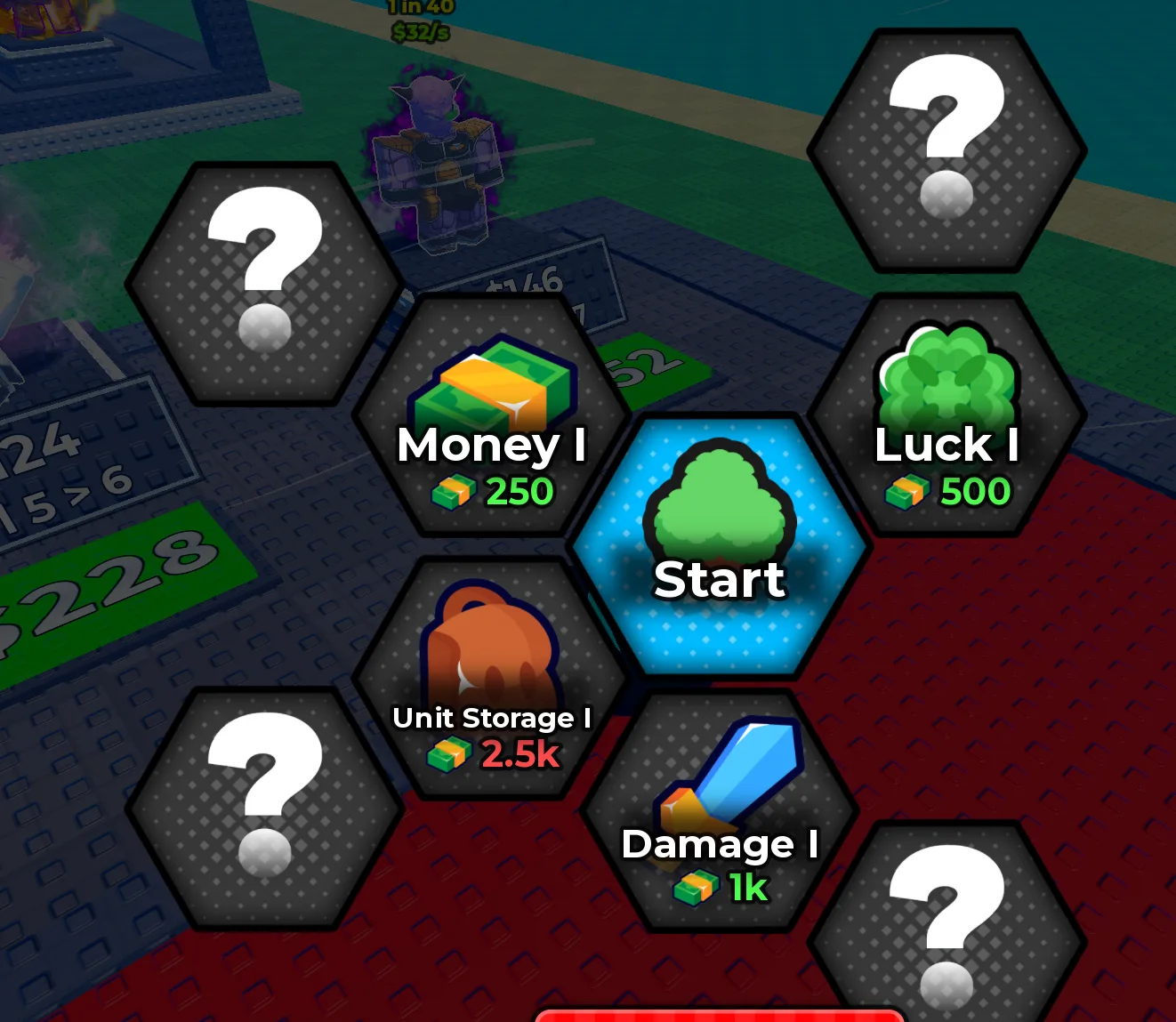
Money improves earning power; dice and Luck upgrades affect future rolls. Pick an affordable improvement or save for one named target such as Water ($10K, 10× Luck). Enter your cash and measured income in the save-versus-upgrade planner before spending the same savings on several options. The displayed Luck number does not guarantee a particular character.
Move on when: you have a useful earning team and can explain which purchase you are saving for. Start planning the first recorded $50K Rebirth before automatically spending $75K on Nature. If you stall: choose storage when the backpack is stopping rolls; otherwise compare the next Money purchase, a better owned copy and your dice-saving time. Roll Speed I is recorded after Luck III; the full node table gives its price and effect.
Watch CHALLS at 0:38–1:13: Money, Luck and other priorities.
3. Reset with your earning team ready
Do this: open Rebirth on the left and read its cash requirement, multiplier changes and reset warning. The recorded first three cash checkpoints are $50K → $5M → $500M. The first changes the listed Cash and Luck multipliers from 1× to 1.5×. Use the current panel if it differs.
Example at $75K: with a $50K requirement, you have $25K of cash headroom. If Water ($10K), Money II ($5K) and Luck II ($10K) are still unowned and available, those three purchases total $25K and leave $50K. Buying Nature for $75K instead leaves no cash for that reset. This is a spending comparison, not a requirement to buy all three; check any other conditions before confirming.
Your cash is wiped. The collected sources report that units, dice, upgrades, Gems and Trait Rerolls remain. Keep earning copies placed, reset when it fits your goal, then collect their pads and fill an extra slot if one opens. Follow the reset steps and use the recovery calculator to compare your actual inputs.
Move on when: the reset is complete and your retained team is earning again. If you stall: a purchase may have taken you below the requirement; rebuild the shortfall rather than assuming the button is broken. After a reset, recheck occupied slots and collect their pads before buying more.
Watch CHALLS at 2:05–3:24: spend surplus, reset and collect. This is his later $500M reset, illustrating the sequence rather than a new-account result.
4. Invest in copies you will keep
Do this: compare the actual Income/s of your copies before replacing one, including its level, size, mutation, Grade and Trait. A rare name alone is not a reason to sell a stronger modified copy. If Equip Best chooses a worse earner, compare and replace it manually.
Choose a keeper, then price the improvement. In the community leveling model below, a level-1 copy earning $100/s with a $1,000 next-upgrade price costs $2,600 to reach level 3 and projects $150/s with unchanged modifiers. Its extra $50/s repays that spending in 52 seconds. This is an illustrative input set; use your copy's displayed values in the level calculator and check whether the detour delays your dice.
Spend Gems on Grade and Trait Rerolls on Traits. Set a budget and an acceptable stopping result before replacing a useful bonus. At the recorded 0.1% S+ chance, 900 independent attempts still have about a 40.6% chance to miss S+. Compare your own reroll risk instead of treating a large budget as a guarantee.
Move on when: each active earning slot holds the copy you chose, and your next resource budget has a named keeper and purpose. If you stall: stop replacing a useful bonus just to chase a letter; compare the next improvement with a free owned replacement. Preserve promising fighters even if they lose the income comparison.
Watch Superlex at 27:14–27:40: the result of roughly 900 Grade attempts. One player's run illustrates the risk; it does not determine your next roll.
5. Turn Tower runs into keeper upgrades
Do this: go to the hub's TOWERS entrance, inspect the current mode and reward panel, select your team and start a run. Dragon/Easy is a useful first comparison; follow the Fight/Auto steps. A cash-focused Trait does not necessarily help combat.
If units fall quickly, compare Health and your weakest fighter. If they survive but barely damage enemies, compare Damage. Change one thing and retry the same mode. For farming, count the resource you need and the time actually spent, including failed runs. A harder mode is worthwhile only if its result helps your current goal.
Superlex's earlier session reached almost floor 100 on Easy and about floor 24 on Medium, then preferred the easier run's resources. That is a comparison from one account, not a clear requirement. Direct Gems toward a keeper's Grade and rerolls toward its Trait; use the two-Tower quest for its listed five Tickets when that objective appears.
Move on when: you can repeat a useful run and name the keeper upgrade its rewards will fund. If you stall: return to a mode with better useful rewards per minute, or rebuild your fighter before paying for another change. For later potion goals, Update 4 adds a new Tower's nine potions and tier-four potions in Infinity; the announcement does not supply their complete drop table.
6. Plan one expensive target at a time
Do this: choose the current shop item, Rebirth or keeper improvement you want next. Record its actual price, your cash and measured income. Recalculate after a new keeper, bonus or reset instead of carrying an old estimate into a changed account.
Illustrative checkpoint: at $800M cash and $1M/s, a $1.5B Shadow target takes 700 seconds of direct saving. If an available unit upgrade costs $100M and adds $250K/s, buying it first leaves $700M cash; the remaining $800M at $1.25M/s takes 640 seconds. That is 60 seconds sooner under fixed-income assumptions. Enter both options in the comparison tool; the upgrade must actually be available at those values.
For a planned reset, cash above the current requirement can fund useful purchases first. The earlier $50B creator checkpoint leaves $10B headroom at $60B cash. The separate 1Qi observation is not a numbered late-game unlock sequence; keep the source conditions with each checkpoint.
The recorded dice ladder reaches Chrono at 15Sx; a later creator session discusses a 100Sx target. Use Custom shop target if your current dice is beyond the list, supplying its price and optional displayed Luck. Compare that later target without guessing its missing name or Luck.
Your next milestone: reach the chosen target, equip or apply the improvement and measure the result before picking another. If you stall: check cash collection, stopped rolls, a worse equipped copy and changed boosts; then revisit the stage causing the shortage. A lucky pull can change the plan, but this route does not promise one.
Watch RexonSIM at 7:26–7:54: weighing the 15Sx and 100Sx targets.
Video links open the relevant creator timestamp on YouTube. The linked passages come from saved September 2026 captions; they are examples from different accounts, not one continuous playthrough or our own gameplay test.
A practical first session
- Complete the introductory tutorial, roll units and fill available plot positions. Walk onto a placed unit's cash pad to collect earnings.
- Claim codes with Auto Roll paused if you want to choose when spins are consumed. Keep Gems and rerolls for a unit that is likely to stay.
- For an income-focused start, prioritize Money and Luck. CHALLS recommends these ahead of Damage/Health; Roll Speed helps repeated rolling, and storage is valuable when your backpack is the actual bottleneck.
- Buy an affordable dice tier and compare the cash you still need for the next one. Avoid spreading the same savings across every tree node without a goal.
- When the backpack is full, inspect/equip your keepers first, then sell unwanted inventory. Check that rolling resumes and that the intended units are still placed.
- Read the next Rebirth threshold. Spend useful surplus without dropping below it, reset when ready, and collect from the remaining plot units to rebuild cash.
- Try a Tower when combat becomes your goal. Turn its useful drops into keeper upgrades rather than treating Damage as passive cash income.
Permanent upgrade reference
Reported captured costs/effects below are dated references, not a complete Update 4 unlock graph. Luck III unlocks Roll Speed I; the other prerequisite edges were not established by the source. Walkspeed III is not filled in from Walkspeed IV.
Evidence labels below describe the source’s own records. This guide has not independently playtested those observations.
| Node | Cash cost | Effect type | Value | Source evidence label |
|---|---|---|---|---|
| Money I | $250 | cash percent | 25% | direct |
| Luck I | $500 | luck multiplier add | 0.25x | direct |
| Damage I | $1K | damage percent | 20% | direct |
| Health I | $1K | health percent | 20% | direct |
| Unit Storage I | $2.5K | unit storage add | 5 | direct |
| Money II | $5K | cash percent | 25% | direct |
| Luck II | $10K | luck multiplier add | 0.5x | direct |
| Damage II | $20K | damage percent | 25% | direct |
| Health II | $20K | health percent | 25% | direct |
| Unit Storage II | $50K | unit storage add | 5 | direct |
| Money III | $100K | cash percent | 35% | direct |
| Luck III | $200K | luck multiplier add | 0.5x | direct |
| Walkspeed I | $250K | walkspeed add | 2 | direct |
| Damage III | $400K | damage percent | 35% | direct |
| Health III | $400K | health percent | 35% | direct |
| Sell I | $500K | sell percent | 25% | direct |
| Roll Speed I | $1M | roll time seconds add | -0.15 | direct; unlocked after Luck III |
| Unit Storage III | $1M | unit storage add | 10 | direct |
| Money IV | $2M | cash percent | 40% | direct |
| Luck IV | $4M | luck multiplier add | 1.0x | direct |
| Walkspeed II | $5M | walkspeed add | 2 | direct |
| Damage IV | $8M | damage percent | 50% | direct |
| Health IV | $8M | health percent | 50% | direct |
| Sell II | $10M | sell percent | 50% | direct |
| Unit Storage IV | $20M | unit storage add | 10 | direct |
| Money V | $40M | cash percent | 40% | direct |
| Luck V | $80M | luck multiplier add | 1.0x | direct |
| Roll Speed II | $100M | roll time seconds add | -0.15 | direct |
| Sell III | $200M | sell percent | 75% | direct |
| Money VI | $800M | cash percent | 50% | direct |
| Luck VI | $1.5B | luck multiplier add | 1.0x | direct |
| Health V | $160M | health percent | 65% | direct |
| Damage V | $160M | damage percent | 65% | direct |
| Walkspeed IV | $2B | walkspeed add | 2 | direct |
| Unit Storage V | $400M | unit storage add | 10 | direct |
Unit levels and variants
AwesWikis reports a level model of I(L) = I(1) × [1 + 0.25 × (L − 1)], with successive upgrade costs increasing by 1.6×. These are community-derived models; display rounding is unresolved. Holding all other modifiers steady, a unit earning $100/s at level 1 would project $200/s at level 5. A level-5 unit earns only another 12.5% from the next +0.25 base step, not 25% of its already doubled income.
Use the unit's actual current level/income and the next upgrade's displayed price to project a target level. Cost is the geometric sum from the current next-price, so the tool works without inventing a universal first-upgrade cost. If your panel disagrees, use the measured result; the model is not developer code. Grade/Trait/Size changes during the comparison invalidate the same-modifier assumption.
Evidence labels below describe the source’s own records. This guide has not independently playtested those observations.
| Dimension | Name | Roll denominator modifier | Source evidence | Source confidence |
|---|---|---|---|---|
| size | None | 1x | baseline | direct |
| size | Huge | 10x | roll denominator x10 | strongly-verified |
| size | Titanic | 100x | roll denominator x100 | strongly-verified |
| mutation | None | 1x | baseline | direct |
| mutation | Silver | 10x | roll denominator x10 | strongly-verified |
| mutation | Gold | 100x | roll denominator x100 | strongly-verified |
| mutation | Emerald | 1Kx | roll denominator x1000 | strongly-verified |
| mutation | Diamond | 10Kx | Diamond Naroto 1/20K from base Naroto 1/2 | directly-verified |
| mutation | Ruby | 100Kx | fits visible mutation tier sequence, direct unit example still missing | high-confidence-inferred |
| mutation | Rainbow | 1Mx | Rainbow Naroto Index 1/2M from base Naroto 1/2 | directly-verified |
The table's factors describe reported Index denominators, not income multipliers or your personal chance after Luck. Ruby's 100K factor is inferred from the source's sequence, with no direct example in that capture. The source additionally gives an empirical level-one estimate round(1.03 × N^0.72 − 0.63), where N is the final variant denominator. Use direct displayed income in the tools when you have it; that fitted estimate and multiplicative Grade/Trait stacking are not established official formulas.
Directly recorded income tiers
The following community-captured values provide a stronger lookup than the fitted formula when your final Index denominator matches a row. Keep the original level/modifier conditions in mind and prefer your own displayed income when they differ.
| Final roll odds | Observed Level 1 or lowest known income |
|---|---|
| 1 in 2 | $1/s |
| 1 in 3 | $2/s |
| 1 in 4 | $2/s |
| 1 in 6 | $3/s |
| 1 in 11 | $5/s |
| 1 in 15 | $7/s |
| 1 in 20 | $8/s |
| 1 in 28 | $11/s |
| 1 in 30 | $11/s |
| 1 in 40 | $14/s |
| 1 in 52 | $17/s |
| 1 in 60 | $19/s |
| 1 in 95 | $27/s |
| 1 in 110 | $30/s |
| 1 in 140 | $34/s |
| 1 in 150 | $37/s |
| 1 in 200 | $46/s |
| 1 in 240 | $53/s |
| 1 in 300 | $62/s |
| 1 in 325 | $66/s |
| 1 in 380 | $74/s |
| 1 in 400 | $77/s |
| 1 in 450 | $83/s |
| 1 in 600 | $103/s |
| 1 in 850 | $132/s |
| 1 in 1.1K | $160/s |
| 1 in 1.2K | $170/s |
| 1 in 1.7K | $219/s |
| 1 in 2K | $247/s |
| 1 in 2.4K | $282/s |
| 1 in 3K | $331/s |
| 1 in 3.2K | $351/s |
| 1 in 3.5K | $371/s |
| 1 in 5K | $480/s |
| 1 in 5.2K | $494/s |
| 1 in 11K | $851/s |
| 1 in 16K | $1.1K/s |
| 1 in 17K | $1.1K/s |
| 1 in 20K | $1.3K/s |
| 1 in 25K | $1.5K/s |
| 1 in 38K | $2K/s |
When do unit levels pay for themselves?
Worked example using the community model: a level-1 unit earns $100/s and its next upgrade costs $1,000. Grade, Trait, size, mutation and other boosts remain unchanged. Each target below starts at level 1; costs are cumulative.
| Target | Total cash spent | Projected income | Extra income | Cost / extra income |
|---|---|---|---|---|
| Level 1 → 2 | $1,000 | $125/s | +$25/s | 40.00s |
| Level 1 → 3 | $2,600 | $150/s | +$50/s | 52.00s |
| Level 1 → 4 | $5,160 | $175/s | +$75/s | 68.80s |
| Level 1 → 5 | $9,256 | $200/s | +$100/s | 92.56s |
The last column is how long the extra earnings take to replace the upgrade cost. Spending $9,256 to reach level 5 adds $100/s, so that cost takes about 92.56 seconds to earn back. It can still delay your next dice if the detour uses cash you need sooner. Put the total cost and extra income into the save-or-upgrade comparison; use the actual displayed values if the model differs from your unit.
Upgrade a copy you intend to keep for at least its payback period. A free replacement that already earns more, an empty earning slot you can fill, or an approaching Rebirth can change the decision.
If progress stops
Full backpack: inspect keepers, sell unwanted copies or buy useful storage, then confirm rolls resume. Low cash: collect occupied pads and compare actual team income; make one focused upgrade. Slow Tower clears: Damage/Health and your equipped team matter. A worse Equip Best result: compare copies manually. Offline income is confirmed by the game description; no cap or full-rate duration is assumed here.
Sources & calculation notes Reviewed 15 Sep 2026
Keep unverified progression rates blank here until the game shows them.
Sources revisited September 15, 2026. Older observations keep their original conditions; a source recheck is not a new in-game test. Calculator outputs are estimates from your inputs.
- AwesWikis · upgrade tree
- AwesWikis · unit leveling
- AwesWikis · size and mutation
- CHALLS · Beginner guide (captions)
- Superlex Plays · Progression (captions)
- Superlex Plays · Grade session (captions)
- RexonSIM · Update 4 session (captions)